

Parrotia persica ‘JL Columnar’ P.A.F.
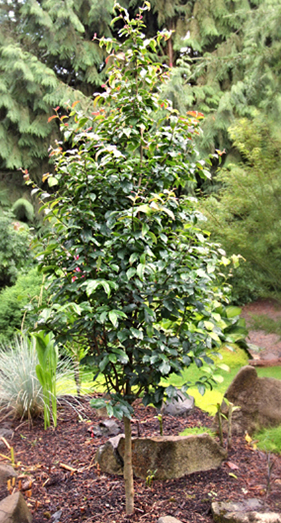
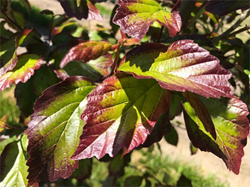
Cultivars of Parrotia persica have been mentioned in past articles but the Persian Spire™ upright ironwood tree, ‘JL Columnar P.A.F.’ merits its own profile. Discovered by John Lewis of JLPN Nursery in Salem, Oregon in 2013, he likely first noted its strong upright growth. He then found that the foliage was finer with a narrower leaf than the common ironwood. In the spring, leaves emerge with a strong purple cast that fades to shiny green, leaving a purple halo margin (see the photo). Summer foliage is a dark emerald green. John observed that the Persian Spire™ has a long lasting, elaborate autumn color display of ever-changing yellow, orange, burgundy and red hues. Up close it is a work of art!
Of the four upright Parrotia trees available that I know of, Ruby Vase®, ‘Vanessa’, Golden BellTower™ and Persian Spire™, the Persian Spire™ is the most unique. At our nursery, this selection grows at half the rate of the others. From liners we planted in 2014, only some have reached 1.5-inch caliper by 2017. The other three selections average 2-inch caliper in the same amount of time. Persian Spire™ has a finer texture, both in twig and leaf development, and a more delicate appearance than the others. Not surprisingly, the leaf shape is similar to witch hazel (Hamamelis), as it is also part of the Hamamelidaceae family.
The bark is gray and becomes platy or flaking with age. The crown can be dense with crooked branches, but in this case with ascending growth habit, and developing an interesting character in form with age. Root development does not appear to be excessive or aggressive enough to heave pavement, but we may need more experience with this after they have been grown in the area for longer time.
There is no reason yet to think that the Persian Spire™ selection does not carry all of the other fine qualities of Parrotia persica. I have never seen any disease or insect problem with Parrotia, and the literature suggests it is a pest free tree. We have found it to transplant moderately easy; however, they are a little slow to establish in some cases.
As a grower and consulting arborist, I am finding slower growing trees to have advantages both in production and in the field. They are available for sale for a longer time and they do not outgrow their space as fast as so many other trees do. This, along with the other many other good qualities just add to its promise. You will however, pay a bit more for this tree because of those qualities and especially the slow growth.
The Persian Spire™ Parrotia is definitely a tree variety to consider as a street, landscape, or garden tree. As always, let me know your experience with this or any other tree of special interest.
As always, let me know your experience with this tree.
CLICK HERE FOR MORE TREE PROFILES
Jim Barborinas
Owner of Urban Forest Nursery, Inc.
ISA Certified Arborist #0135
ASCA Registered Consulting Arborist #356
15119 McLean Rd.
Mount Vernon, WA 98273
jim@urbanforestnursery.com
Curious how Persian Spire™ Upright Ironwood performs in landscapes and urban spaces?
Here are some common questions people ask about this tree:
Persian Spire™ stands out for its narrow, upright form, fine-textured leaves, and delicate branching. Its fall color is long-lasting and dramatic, with shades of yellow, orange, burgundy, and red that create an ever-changing display in the landscape.
This selection typically reaches about 25–30 feet tall with a 10–12 foot spread, maintaining a strong vertical habit that works well in streets and tighter landscape spaces. Its crown can develop interesting character as it matures.
Yes — its narrow, upright form and slow growth make it a great choice for urban planting, boulevards, and other areas where space is limited but structure and ornamental value are desired.
Absolutely — Persian Spire™ offers striking summer foliage with a purple halo margin, transitioning to dark green, and then an elaborate display of autumn colors that are vivid and multi-toned.
Plant in well-drained soil with room to establish. This tree transplants moderately easily but can be slow to establish, so giving it space and care during the early years helps ensure a strong, upright structure.